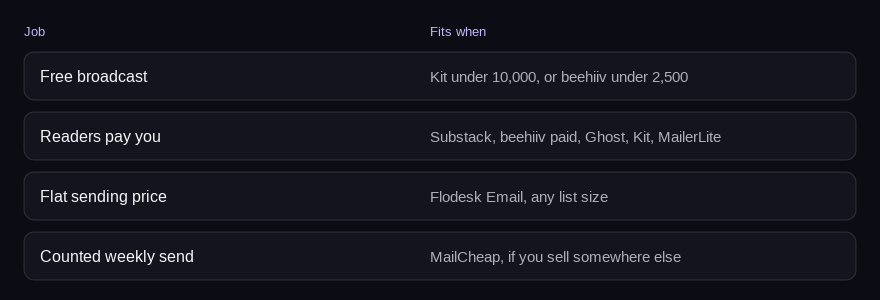
The eight products are Kit (formerly ConvertKit), beehiiv, Substack, MailerLite, Ghost(Pro), Flodesk, Mailchimp, and MailCheap. An email newsletter can run on any of them. Email newsletters that also sell access, host a member site, or meter every send are where the products stop being substitutes. The cost guide is the bill by list size and by how often you send. The sections below say which product that bill belongs to.
Read a row in four passes. First, can it send the issue you described. Second, the monthly price at your list size. Third, the annual price as its own charge, not as a cheaper monthly withdrawal. Fourth, the feature the cheaper row does not have. Newsletter platforms that look expensive on the monthly column are sometimes the only row that can take a reader payment or host the member site. Newsletter platforms that look cheap can be the wrong invoice the week you need that feature.
Which newsletter platforms fit which job
Use the row that matches the letter you will send this year. Each row below names one kind of letter.
| Job this year | Fits | Poor fit |
|---|---|---|
| Broadcasts only, under 10,000 subscribers, sequences can wait | Kit Free at $0 | A $19 or $46 plan you do not need yet |
| A site and recommendations, under 2,500 subscribers | beehiiv Free at $0 | Paying Lite for features Free already includes |
| Readers will pay, and revenue is still small | Substack at $0 to publish, then 10% | A $59 to $109 monthly tier that exceeds 10% |
| Members log in to a site you theme | Ghost Publisher, 0% of payments | MailCheap, which cannot sell memberships |
| Published tiers, pages, and automations | MailerLite Comfort or Power | Mailchimp, until you have read the contact price |
| One sending price at any list size | Flodesk Email at $46 a month, or $456 a year | Flodesk Free, which does not send |
| The account already runs a store | Mailchimp, if the journeys stay | Leaving only to chase a price you have not opened |
| Weekly send past the free caps, sold elsewhere | MailCheap’s published plan | MailCheap, if you need a paywall inside the tool |
Kit’s free plan fits the first row. Ghost Publisher fits a membership site even when the monthly price is higher than a send-only plan. MailCheap fits a counted weekly send once the free caps are gone and the paywall is not the product. Flodesk Email fits a flat bill when the list is large enough that per-subscriber tiers have passed $46 and you are not using those tiers’ extra tools. Matching one row is not a reason to ignore the other seven.
Free newsletter platforms, in the sense of a $0 plan that sends, are Kit, beehiiv, Substack, and the small free caps on MailerLite and Mailchimp. A free newsletter on Flodesk is a form. A free newsletter on Ghost or MailCheap means self-hosting, a server bill that neither vendor publishes a price for.
Estimated monthly platform bill for 1,000 subscribers and 1 issue a week (4,334 emails a month). Month-to-month USD list prices.
The calculator includes every product in the tables. Change the list size and the issues per week. A result that says “Check current pricing” is Mailchimp above 500 contacts, or Kit’s paid price outside the figures Kit states in writing. For a weekly broadcast under 10,000 subscribers, the $0 rows that already send fit that broadcast.
Newsletter platforms at 1,000, 5,000, and 10,000 subscribers
One issue a week. About 4,300 emails at 1,000 people, about 21,700 at 5,000, and about 43,300 at 10,000. Monthly list prices. The annual table is next. Substack’s $0 is the publishing plan, not a promise that a paid publication is free. The 10% is a revenue fee, documented on the monetization guide.
| Platform | 1,000 | 5,000 | 10,000 |
|---|---|---|---|
| Kit, broadcasts | $0 | $0 | $0 at the cap |
| Kit Creator, if you need sequences | $39 | Check current pricing | Check current pricing |
| beehiiv | $0 Free, or $59 Lite | $109 Lite | $139 Lite |
| Substack | $0 to publish | $0 to publish | $0 to publish |
| MailerLite Comfort | $19 | $49 | $89 |
| Ghost(Pro) | $18 Starter, or $35 Publisher | $75 Publisher | $105 Publisher |
| Flodesk Email | $46 | $46 | $46 |
| Mailchimp | Check current pricing | Check current pricing | Check current pricing |
| MailCheap | $19 Starter | $39 Growth | $39 Growth |
Annual charges, paid up front. The parenthetical per-month figure is the yearly total divided by 12. It is not what the card is charged every month.
| Plan | 1,000 | 5,000 | 10,000 |
|---|---|---|---|
| Kit Creator | $390 for the year | Check current pricing | Check current pricing |
| beehiiv Lite | $588 for the year | $1,140 for the year | $1,428 for the year |
| MailerLite Comfort | $17.10 a month, for the year | $44.10 a month, for the year | $80.10 a month, for the year |
| Ghost | Starter $180. Publisher $348. | Publisher $756 | Publisher $1,056 |
| Flodesk Email | $456 for the year, at any list size | ||
| MailCheap | $190 for the year, Starter | $390 for the year, Growth | $390 for the year, Growth |
At 5,000 subscribers, MailCheap’s weekly email count is about 21,700, which is over Starter’s 20,000, so the monthly row is Growth. A month with five weekly sends is higher than that 4.33-week estimate, before welcomes and tests. At 5,000 people it is 25,000 emails, which still fits Growth’s 75,000. It does not put you back on Starter.
What each product is for
Each note uses the same questions: when it fits, what you pay at the three list sizes, what the annual term is, and what it does not do. The links go to the longer pricing page.
Kit (formerly ConvertKit)
Kit fits broadcasts, forms, and a creator list. The free plan, help article updated 23 September 2026 and checked 25 November 2026, is $0 up to 10,000 subscribers with unlimited email broadcasts. Sequences, visual automations, rules, and RSS need Creator or Pro. Commerce, including a paid newsletter, is on every plan including Free, at 3.5% plus $0.30 per USD sale. Kit’s help says that figure is the only cost of selling through Kit.
At 1,000 subscribers, broadcasts are $0. Creator is $39 a month if you need sequences, or $390 for the year, because annual is 12 months for the price of 10. The billing help uses $59 a month as Creator up to 3,000 subscribers. At 5,000 and at 10,000, broadcasts stay $0. The paid price above 3,000 subscribers is on kit.com/pricing. Pro was $79 a month at 1,000 subscribers on that page on 24 November 2026. Above that, check current pricing on Kit.
Kit does not meter issues. A daily letter does not move the free plan. Passing 10,000 subscribers does: you pay to keep sending. Among newsletter platforms, Kit is the wrong one if the product is a themed member site the way Ghost means it, or if you want beehiiv’s ad network. It is the right one if the broadcast is the product and 10,000 is still ahead of you. The Creator Network can recommend other letters. Paid plans get priority in that network, and earning from paid recommendations needs a paid plan. You can turn recommendations off. Pricing write-up: Kit pricing. Pairs: Kit vs Mailchimp and beehiiv vs Kit.
beehiiv
beehiiv fits a publication site, recommendations, and, on paid plans, ads and subscriptions at a 0% take rate. Free is $0 up to 2,500 subscribers and unlimited sends. It does not include automations, paid subscriptions, the ad network, or custom domains. The pricing file checked 25 November 2026 puts the 0% take rate on Lite and Pro, not during the trial. Stripe is still 2.9% plus $0.30 per transaction, as beehiiv states it.
At 1,000 subscribers, Free is $0 and Lite is $59 a month or $588 for the year. At 5,000, Lite is $109 a month or $1,140 for the year. At 10,000, Lite is $139 a month or $1,428 for the year. Sends are unlimited, so a second issue in the week does not change the tier. The list size does.
beehiiv is the wrong way to save money if you will not use recommendations, ads, or the paid tools and a send-only plan is cheaper. It is the right move if those are the reason you publish. The pricing file lists unlimited posts, and it caps podcast downloads at 5,000 a month on Free, 15,000 on Lite, and 50,000 on Pro. A podcast-heavy publication can outgrow Free before the subscriber cap does. Pricing: beehiiv pricing. Pairs: beehiiv vs Substack, beehiiv vs Kit, MailCheap vs beehiiv.
Substack
Substack fits writers who want $0 until readers pay, and who want Substack’s own network and app. The help article, updated 29 October 2026 and checked 25 November 2026, says publishing is free at any list size. Paid subscriptions cost 10% plus Stripe. The article quotes 2.9% plus $0.30 for US cards and 0.7% for Stripe Billing. A custom domain is $50 once. There is no monthly tier at 1,000, 5,000, or 10,000 subscribers. At $1,000 a month of reader revenue the platform fee is $100 before Stripe. At $5,000 it is $500. At $10,000 it is $1,000.
Substack is the lower platform bill while 10% is smaller than the monthly plan you would switch to. At $400 a month of revenue, 10% is $40, which is under Lite at 5,000 subscribers ($109). It is the higher bill once revenue passes that tier, if you can replace the network. Notes, the app, and recommendations inside Substack are the part a cheaper sender does not copy. It is the wrong tool if you want a 0% cut and a site you theme yourself. Pricing: Substack pricing. Pairs: beehiiv vs Substack and Ghost vs Substack.
MailerLite
MailerLite fits a published price, landing pages, automations, and, on paid plans, a paid newsletter. The pricing file, checked 25 November 2026 and dated 8 September 2026 by MailerLite, sets Free at 250 active subscribers and 2,500 emails a month. Comfort at 1,000 subscribers is $19 a month. Annual is 10% less, shown as $17.10 a month, paid for the year. At 5,000, Comfort is $49 a month or $44.10 on the annual schedule. At 10,000, Comfort is $89 a month or $80.10 annually. Power removes the email cap: $39, $69, and $129 a month at those three sizes, or $35.10, $62.10, and $116.10 on the annual schedule.
Comfort’s email allowance is 10 times the tier. A weekly issue fits Comfort at these sizes. A daily issue often does not, and Power is then the cheaper published plan that fits. The cost guide has that daily table. Paid newsletters are off on Free and on for Comfort and Power. MailerLite’s creator FAQ says the company takes 0% commission and that Stripe is the processing fee, quoted there at 2.9% + $0.30 for US cards.
Do not leave MailerLite if you use the pages and the automations and the price is your only complaint. It is the right comparison when you want those features at a published tier instead of a contact price you have to open a slider to see. Comfort includes a custom domain, logo removal, and a set number of automations, sites, and forms. Power is the step when the email cap, not the subscriber count, is what broke. Pricing: MailerLite pricing. Pair: MailerLite vs Mailchimp.
Ghost(Pro)
Ghost fits a membership site: members, themes, and a 0% transaction fee on the plans that can charge. The pricing page and price file, checked 25 November 2026, set Starter at $18 a month or $180 a year, up to 1,000 members, without paid subscriptions. Publisher at 1,000 members is $35 a month or $348 a year. At 5,000 members Publisher is $75 a month or $756 a year. At 10,000, Publisher is $105 a month or $1,056 a year. Sends are unlimited. Stripe charges in your Stripe account.
There is no hosted free plan. Starter can send a newsletter and cannot sell memberships. The custom sending domain is listed on Publisher, not on Starter. A custom website domain is listed on Starter. If the site is the product, Publisher’s higher bill can be the one that fits, and a cheaper sender is not a substitute. If you were only paying Ghost to email a list, compare a send-only plan before you renew. Themes from the marketplace and custom themes start on Publisher. Starter uses design settings on the default theme. Pricing: Ghost pricing. Pair: Ghost vs Substack.
Flodesk
Flodesk fits a design-led send at a price that does not grow with the list. Checked 25 November 2026: Email is $46 a month or $456 a year, with unlimited subscribers and unlimited emails. Everything, which adds checkout, is $99 a month or $948 a year. The free plan does not include email sending or workflow automations. There is no cheap sending tier under Email.
At 1,000, 5,000, and 10,000 subscribers the monthly sending price is $46 every time. At 1,000, that is more than Kit Free, MailerLite Comfort, and MailCheap Starter. At 10,000, $46 is less than beehiiv Lite at $139 and MailerLite Comfort at $89, and more than MailCheap Growth at $39 for a weekly issue of about 43,300 emails. Flodesk says it adds no transaction fee on top of Stripe for checkout on Everything. Checkout is limited to businesses in the countries listed on the pricing page.
Flodesk is the wrong tool if you wanted a free send. It is a coherent tool if the flat Email price is the feature you are buying and you will use the editor. Workflow automations, A/B tests, and branding removal are on Email, not on Free. A dedicated IP is an add-on; Flodesk does not publish its price. Pricing: Flodesk pricing. Pair: Flodesk vs Mailchimp.
Mailchimp
Mailchimp fits an account that already runs a store, journeys, and an audience you are not ready to rebuild. It is a weaker fit for a newsletter-only list above 500 contacts. The published starting prices stop at that tier. Free is 250 contacts and 500 sends a month, with a daily cap of 250. Essentials starts at $13 a month and Standard at $20 a month, both for up to 500 contacts, as listed on Mailchimp’s plan pages on 24 November 2026. At 1,000, 5,000, and 10,000 contacts, check current pricing on mailchimp.com/pricing/marketing. Subscribed, unsubscribed, and non-subscribed contacts count until you archive them.
Mailchimp does not list a percent for paid newsletters.
Stay when the store and the journeys are the product. Leave when you are paying the contact tier only to send a weekly letter and you have read the actual tier. Mailchimp is included because many stores already send from it. Above 500 contacts, check current pricing on Mailchimp. The alternatives roundup is Mailchimp alternatives. Pairs: MailerLite vs Mailchimp, Kit vs Mailchimp, Flodesk vs Mailchimp.
MailCheap
MailCheap fits a scheduled send you can count, sold somewhere else if you sell at all. It does not fit a paywall, an ad network, a referral program, or A/B tests inside the sending tool. The plans page (affiliate link), checked 25 November 2026, lists Starter at $19 a month for 20,000 emails and 10,000 subscribers, Growth at $39 for 75,000 emails and 40,000 subscribers, and Pro at $79 for 200,000 emails and 100,000 subscribers. Yearly billing costs the price of 10 months: Starter is $190 for the year, Growth is $390. There is no hosted free plan. You can draft before you pay. Sending requires a paid plan.
At 1,000 subscribers and one weekly issue, about 4,300 emails, Starter fits. At 5,000, about 21,700 emails, Growth fits and Starter does not. At 10,000, about 43,300 emails, Growth still fits. A daily letter changes those rows. At 1,000 people, daily is about 30,300 emails, which is Growth at $39. At 10,000, daily is about 303,300 emails, which is Scale at $149, because Pro stops at 200,000. The same list on beehiiv or Kit does not pay more for the extra issues. That is the trade. MailCheap’s own comparison pages list paid subscriptions as not included. A sponsor line, or a link to a checkout on another site, is still a send MailCheap can do.
Every paid plan includes the same feature set. The price changes the allowances, not a locked automation. Welcome, confirmation, test, and automation emails count toward the cap. The issue-only tables above do not include them. If the weekly issue already uses most of the cap, check the price of the next plan before you turn the welcome on. Signup forms, a public site for the issues, and a custom domain are on the paid plan. MailCheap reviews a new newsletter before the first issues and refunds the first payment if it cannot take the account. That is a review of who is sending.
The MailCheap review covers the limits. The pair with a subscriber tier is MailCheap vs beehiiv.
See MailCheap pricingRead the MailCheap reviewAffiliate link. We may earn a commission. The price you pay does not change. The review lists the features MailCheap does not include.
Newsletter software, a newsletter service, and a free plan
All eight are hosted email newsletter platforms, so each one runs the sending servers for you, including MailCheap’s paid plans and Ghost(Pro). For broadcasts under 10,000 subscribers, when sequences can wait, the newsletter software that fits is Kit’s free plan. Pick one newsletter platform from the job table, then read its price at your list size. Self-hosting Ghost or MailCheap is a different bill, and neither pricing page gives a number for the server.
Email newsletter software that is “free” still has a cap or a missing feature. The caps are above. A graphics tool that can draw an email is not one of these products. It does not authenticate a domain, count a complaint, or store an unsubscribe. Design the issue wherever you like. Send it from a product that does those jobs.
A newsletter website, the public archive, comes with several of these tools and is not a second subscription on them. Custom domains are the exception that sometimes costs money: Substack’s $50 once, beehiiv’s custom domain on paid plans only, Ghost’s custom sending domain on Publisher rather than Starter. The setup steps for SPF, DKIM, and DMARC are on how to start a newsletter.
Moving is a CSV of people who asked to be mailed, plus a new checkout if they were paying. Paid subscriptions do not become paid subscriptions on the next product by themselves. Read the pair page before you export. The alternatives hub is the set of “if you leave” pages: Mailchimp, MailerLite, Substack, Kit, Ghost, and beehiiv.
Where to read two products at a time
The comparisons hub is every pair. The pricing hub is every vendor table. Use a pair when you are down to two names. Use a pricing page when you need the bucket this matrix skipped, such as beehiiv at 25,000 subscribers or Ghost Business.
- MailCheap vs beehiiv
- beehiiv vs Substack
- MailerLite vs Mailchimp
- Kit vs Mailchimp
- Ghost vs Substack
- beehiiv vs Kit
- Flodesk vs Mailchimp
- beehiiv pricing, Kit pricing, Flodesk pricing, MailerLite pricing, Mailchimp pricing, Ghost pricing, Substack pricing
If the list or the schedule changes, rerun the calculator before you switch. A price that was right at 1,000 subscribers and one issue a week is not automatically right at 10,000, and it is not automatically right for a daily letter on a tool that counts emails.
FAQ
Which newsletter platforms are free to send from?
Kit Free sends broadcasts up to 10,000 subscribers. beehiiv Free sends up to 2,500. Substack publishes at $0 until readers pay. MailerLite Free stops at 250 subscribers and 2,500 emails a month. Mailchimp Free stops at 250 contacts and 500 sends. Flodesk's free plan does not send. Ghost and MailCheap have no hosted free sending plan.
Which plan fits a weekly letter under 10,000 subscribers?
Kit's free plan fits broadcasts in that range when you do not need sequences. It is the wrong fit when you need a membership site, an ad network, or a paywall on beehiiv before 2,500 subscribers. Those are different jobs, and they have their own rows below.
Is Substack or beehiiv the lower bill?
Substack is $0 to publish, then 10% of subscription revenue plus Stripe. beehiiv Free is $0 up to 2,500 subscribers. At 4,000 subscribers Lite is $109 a month, or $95 a month if you pay $1,140 for the year, and paid plans take 0%. The lower one depends on list size and on how much readers pay. The pair page is beehiiv vs Substack.
What does Mailchimp cost at 5,000 contacts?
Check current pricing. Mailchimp publishes Free at 250 contacts, and Essentials from $13 a month and Standard from $20 a month for up to 500 contacts. Above 500 contacts the price is on Mailchimp's pricing page.
Do I need a newsletter website as well as a sender?
You need a page for the form. A public archive is optional. beehiiv, Ghost, Substack, MailerLite, Kit, and MailCheap can host pages. Flodesk hosts pages on the free plan and still requires a paid plan to send. The website is not a separate bill on the tools that include it. A custom domain sometimes is.
When is a flat price the lower bill?
Flodesk Email is $46 a month at any list size, or $456 for the year. That is less than beehiiv Lite at 10,000 subscribers ($139 a month) and more than MailCheap Growth for a weekly letter at that size ($39). It fits a sender who wants one design-led price and will not use another tool's growth network. It is a poor trade if Kit Free already sends the issue.
Can these tools charge readers?
Substack, Kit, beehiiv Lite and Pro, Ghost Publisher and Business, MailerLite Comfort and Power, and Flodesk Everything can. beehiiv Free, Ghost Starter, MailerLite Free, Flodesk Email, and MailCheap cannot sell the subscription inside the product. Fees are on the monetization guide.
View MailCheap pricing Back to the cost calculator Affiliate link. We may earn a commission. This does not change the price you pay. sendforless is not MailCheap.