Recommendation
Use MailCheap for a regular send you can count. Pick another tool if the business is the paywall or the network.
We would use the hosted product for a weekly or twice-weekly letter whose money is made somewhere else: a job, a course, sponsorships you sell yourself, a site that already exists. We would not use it to launch a paid newsletter, to run an ad network, or to avoid paying anything at all.
That recommendation is from the pricing and help published pages on 25 November 2026. Where a behavior is described below, it is their documentation.
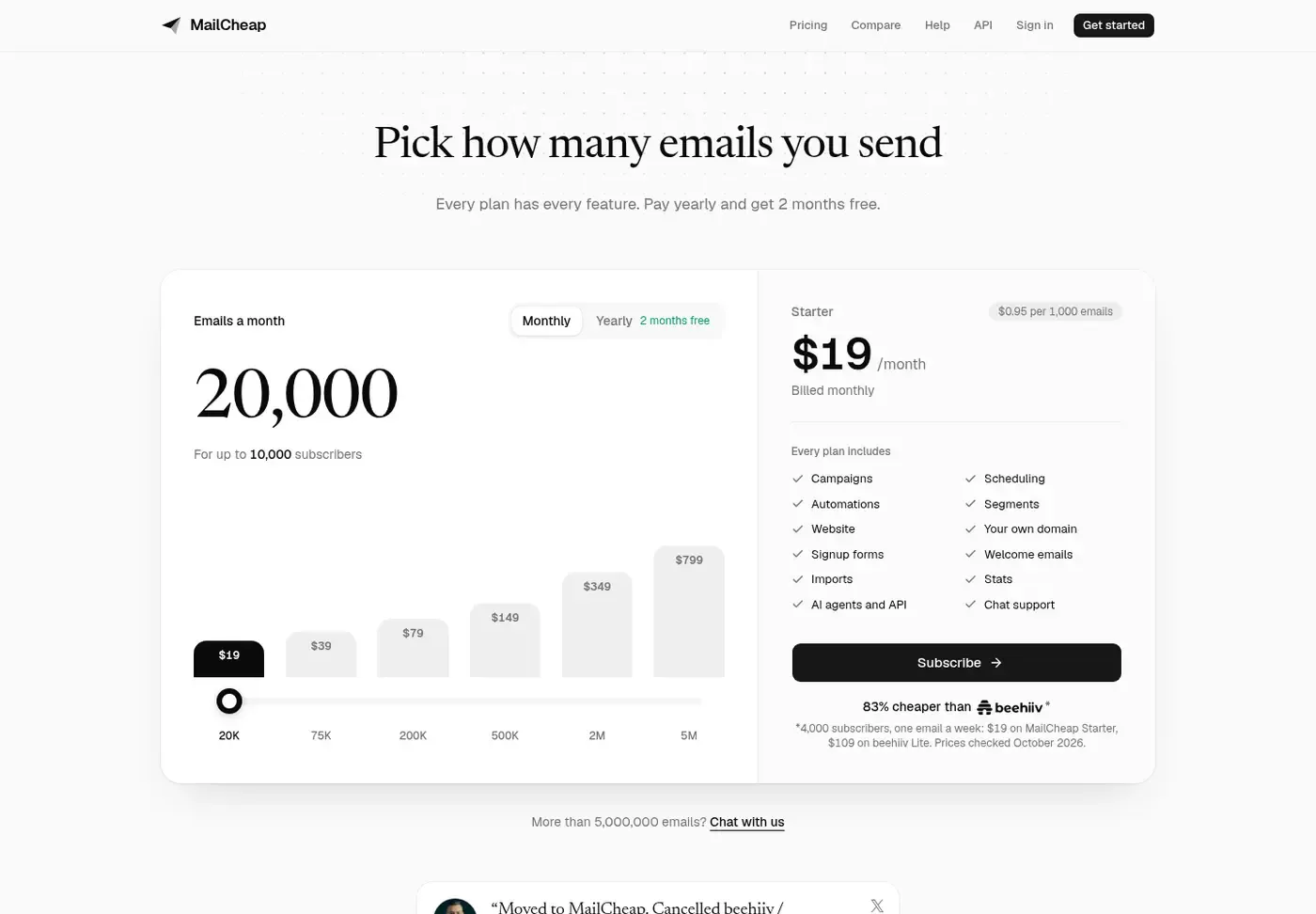
What are the MailCheap plans?
Checked against MailCheap’s plans help and the pricing page on 25 November 2026. A yearly plan costs ten times the monthly price.
| Plan | Emails / month | Subscribers | Monthly |
|---|---|---|---|
| Starter | 20,000 | 10,000 | $19 |
| Growth | 75,000 | 40,000 | $39 |
| Pro | 200,000 | 100,000 | $79 |
| Scale | 500,000 | 250,000 | $149 |
| Max | 2,000,000 | 1,000,000 | $349 |
| Ultra | 5,000,000 | 2,500,000 | $799 |
Above Ultra, MailCheap says to contact them. You pay the plan price even if you send fewer emails. The saving versus subscriber pricing shows up when the other tool’s bucket is large and your send volume is not. Compare a real month in the calculator.
At 4,000 subscribers, one issue a week is about 17,300 emails, which fits Starter. A month with five weekly sends is 20,000 emails. That uses the whole Starter allowance before welcome emails and tests. If you send those, budget $39 for Growth.
See MailCheap pricingCompare with beehiivAffiliate link. We may earn a commission. The price you pay does not change.
What counts as an email on MailCheap?
MailCheap’s help says every email it sends for you: issues, automation emails, last-chance emails, tests, and welcome and confirmation emails. An issue to 1,000 people is 1,000 emails. The count resets each month on the day the plan started. Yearly plans get the same monthly allowance. They do not bank unused months.
Subscribers are active contacts who receive issues. Unconfirmed, dormant, unsubscribed, bounced, and complained contacts stay in the database and do not count toward the cap. That differs from Mailchimp, which bills unsubscribed contacts until you archive them.
There is no general free trial. MailCheap’s help describes a narrower case: if they cannot take a new newsletter on, or a new account is blocked before the second issue and before renewal, they cancel and refund the first payment. Read that on their site before you treat it as a money-back guarantee. Treat that as their policy for accounts they will not onboard.
What a paid plan includes
MailCheap says every plan has the same features, and the published docs match a single feature set gated by volume:
- Campaigns, tests, and scheduling.
- A newsletter website, signup forms, and a custom domain once the domain is verified.
- Automations. You can draft them before you pay. Turning them on requires the plan.
- Segments, CSV import and export, a REST API, and an MCP server, on a paid plan.
- List cleanup on by default: readers who ignore issues can be moved off the active send. Check the setting if your list is new and quiet for ordinary reasons.
Documented import sources include beehiiv, Substack, Mailchimp, and Kit. The importer keeps status when the file has it. A purchased list is against the import rules.
What it does not include
- No free hosted plan. Kit is free to 10,000 subscribers for broadcasts. beehiiv is free to 2,500. Substack has no monthly platform fee.
- No paid subscriptions. beehiiv (Lite and Pro) and Ghost(Pro) Publisher sell paid subscriptions for a monthly plan price with a 0% platform fee. Substack takes 10%. If the business is the paywall, MailCheap is not in the set.
- No ad network and no referral program. You can paste a sponsorship you sold yourself. You cannot turn on a marketplace.
- No A/B tests.
- No membership website in the Ghost sense. There is a newsletter site. There is not a member portal with tiers.
If any line in that list is the plan, use the other tool. The MailCheap vs beehiiv page is the price gap next to those missing features. How we compare prices is the source list.
FAQ
Is this an official MailCheap review?
sendforless is independent. A purchase through a MailCheap link may earn a commission. sendforless does not speak for MailCheap, and MailCheap does not publish this review.
Is there a score?
No. A single number would hide that MailCheap fits a price-sensitive sender with a known cadence, and does not fit a paid newsletter or a recommendation business.
Is there a free plan?
There is no free hosted plan and no trial. Hosted plans start at $19 a month. MailCheap also offers a self-hosted version (see mailcheap.ai/self-hosted). Affiliate link. Running it yourself removes MailCheap’s invoice and leaves you with servers, DNS, and deliverability.
What happens at the cap?
MailCheap’s help says signups keep working and confirmation emails still go out. A campaign that needs more emails than you have left waits until you upgrade or the next month starts. Once the allowance is gone, welcome emails pause. Automation emails wait.
View MailCheap pricing Back to the cost calculator Affiliate link. We may earn a commission. This does not change the price you pay. sendforless is not MailCheap.