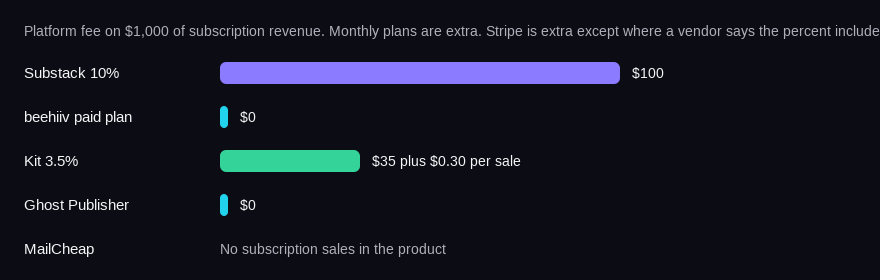
The sections below keep the platform fee, the monthly plan, and outside checkouts in separate lines. A monthly plan can be $0 while the percent is $100. A monthly plan can be $109 while the percent is $0.
How newsletter monetization works
Readers pay you, a sponsor pays you, or both. How to monetize a newsletter is the decision of which of those payments the software is allowed to touch. Paid subscriptions are one form of newsletter monetization. A sponsor line is another.
A paid subscription is the reader payment. You set the price. The platform either takes a percent, takes nothing and bills you a plan, or cannot do the sale. How newsletters make money in the subscription case is that gap between the price and the fees, times the number of people who keep paying. Churn is not in any vendor’s pricing table. Do not treat a full list as a full set of payers.
Email monetization is the wider version: a course, a booking, or a file, not only the recurring letter. Kit’s help article, updated 3 September 2026 and checked 25 November 2026, says commerce includes a paid newsletter on every plan, including Free. MailerLite’s pricing file allows one digital product on Free and turns on paid newsletters only on Comfort and Power.
A sponsorship is a payment you usually invoice yourself. The letter is the ad. Any of the eight sending tools can carry that line, including MailCheap. The platform fee tables below do not apply to a sponsor check that never enters the platform. The commercial-email rules still apply to the issue. The setup page covers those rules: how to start a newsletter.
An ad network is the platform finding the sponsor. beehiiv’s pricing file lists the ad network on Lite and Pro, not on Free, not during the trial, and not in every region. The file does not publish a rate card. If the network is why you would pay for Lite, price Lite from the beehiiv pricing table and treat ad revenue as unknown until beehiiv shows it in the account.
How do newsletters make money?
Newsletter monetization, in practice, is reader payments, a sponsor you invoice yourself, or both. Reader payments are a subscription or a one-time digital product. Sponsor payments are a line in the issue. beehiiv’s ad network, on Lite and Pro, is a third path, and the pricing file does not publish a rate for it. Starting a newsletter business means that mix plus the monthly software plan. The fee tables are the software’s cut. They are not a forecast of what readers or sponsors will pay.
Platform fees
Sources are linked in each row. Checked 25 November 2026.
| Platform | Sells a reader subscription | Platform fee | Processing |
|---|---|---|---|
| Substack | Yes | 10% of subscription revenue | Stripe on top. The help article quotes 2.9% + $0.30 for US cards and 0.7% for Stripe Billing. |
| beehiiv | Lite and Pro. Not Free. Not during the trial. | 0% on those paid plans | Stripe. beehiiv quotes 2.9% + $0.30 per transaction. |
| Kit | Yes, including the free plan | 3.5% + $0.30 per USD transaction | Kit’s help says that figure is the only cost of selling through Kit. Do not add a second card fee on top. |
| Ghost(Pro) | Publisher and Business. Not Starter. | 0% on Publisher and Business | Stripe, in your own Stripe account. |
| MailerLite | Paid newsletters on Comfort and Power. Not on Free. | 0% commission, per MailerLite’s creator FAQ | Stripe. That FAQ quotes 2.9% + $0.30 for US cards. |
| Flodesk | Checkout, including subscriptions, is on Everything. Not on the free plan or Email. | Flodesk says it adds no transaction fee on top of Stripe | Stripe’s rate. Checkout is limited to businesses in the countries Flodesk lists. |
| MailCheap | No | None, because the sale is not offered | None inside MailCheap |
Substack’s source is the help article How much does Substack cost?, updated 29 October 2026 and checked 25 November 2026. Publishing is free at any list size. The 10% applies when readers pay. A custom domain is $50 once. It is not a monthly fee. In-app iOS purchases can be priced higher so Apple’s fee is covered. Substack’s 10% on those purchases is based on the web price. The Substack pricing page walks the Stripe examples, including local payment methods.
beehiiv’s source is beehiiv.com/pricing.md, checked 25 November 2026. The feature list puts “0% Take Rate on Paid Subscriptions” on Lite, and the FAQ says beehiiv takes 0% of paid subscription revenue, minus Stripe. Free does not include paid subscriptions. The 0% rate is marked “not in trial.” The monthly Lite or Pro bucket is still due. At 1,000 subscribers Lite is $59 a month, or $588 for the year ($49 a month on the annual schedule). At 5,000 subscribers Lite is $109 a month, or $1,140 for the year. At 10,000 subscribers Lite is $139 a month, or $1,428 for the year. Those annual figures are the yearly charge, not a coupon on the monthly invoice.
Kit’s source for the percent is Sell digital products with Kit, updated 3 September 2026 and checked 25 November 2026. Selling in USD costs 3.5% + $0.30 per transaction. The same article says there is no monthly fee for commerce and that this is the only cost of selling through Kit. Other currencies use a different fixed amount. The currency article, updated 11 June 2026, lists them. The figures below use the USD row only. Creator and Pro are extra only if you need the features that Free withholds, such as sequences. The commerce percent does not replace those plans, and those plans do not replace the percent.
Ghost’s source is the pricing page and the price file it loads, ghost.org/pricing and pricing.min.js, read 25 November 2026. Starter is $18 a month, or $180 a year, up to 1,000 members, and the feature table marks paid subscriptions as not included. Publisher and Business show a 0% transaction fee. Stripe still charges. Publisher at 1,000 members is $35 a month, or $348 a year. The comparison with the 10% fee is Ghost vs Substack.
MailerLite’s plan grid is mailerlite.com/pricing.md, checked 25 November 2026. The file’s own date is 8 September 2026. “Send paid newsletters” and “Sell recurring subscriptions” are yes on Comfort and Power and no on Free. The 0% commission sentence is from MailerLite’s creator FAQ, checked the same day, which says the only fee on those sales is Stripe and quotes 2.9% + $0.30 for US cards. That page also advertises a short promotion. Plan prices below ignore the promotion and use the pricing file. Comfort at 1,000 subscribers is $19 a month. Annual billing is 10% less, shown in the file as $17.10 a month, which you pay for the year.
Flodesk’s source is flodesk.com/pricing, checked 25 November 2026. Everything is $99 a month, or $948 a year ($79 a month on the annual schedule). The pricing FAQ says Flodesk does not add a transaction fee on top of Stripe, and that checkout is for businesses in the US, Canada, the UK, Australia, New Zealand, and Euro Area countries. The Email plan is the sending plan, at $46 a month or $456 a year, and it does not include that checkout. The free plan does not send email.
MailCheap’s plans were checked the same day on the plans help page. Affiliate link. Starter is $19 a month for 20,000 emails and 10,000 subscribers. Yearly billing costs the price of 10 months. Paid subscriptions are listed as “No” on MailCheap’s own comparison with Substack. That is a product limit, not a discount. If the letter’s business is the subscription, MailCheap is the wrong tool this year. If the letter’s business is a sponsor or a checkout on another site, the limit is not the deciding one.
See MailCheap pricingRead what MailCheap does not sellAffiliate link. We may earn a commission. The price you pay does not change. The review states that paid subscriptions are not included.
The fee at $1,000, $5,000, and $10,000 a month
These rows are the platform’s cut of subscription revenue. They assume the dollar amount is what readers paid for subscriptions, before refunds and tax. They do not add the monthly plan, and they do not add Stripe, except for Kit, where the published USD fee already includes processing.
Kit’s fixed $0.30 depends on how many sales make up the revenue. The table shows the 3.5% alone, then one worked example. The example assumes every payment is $10. A different price changes the count of sales and the fixed fees. It does not change the 3.5%.
| Revenue / month | Substack 10% | beehiiv, Ghost, MailerLite, Flodesk Everything | Kit, 3.5% |
|---|---|---|---|
| $1,000 | $100, plus Stripe | $0 platform fee, plus Stripe, plus the monthly plan | $35, plus $0.30 per sale. At $10 a sale, 100 sales add $30, so $65. |
| $5,000 | $500, plus Stripe | $0 platform fee, plus Stripe, plus the monthly plan | $175, plus $0.30 per sale. At $10 a sale, 500 sales add $150, so $325. |
| $10,000 | $1,000, plus Stripe | $0 platform fee, plus Stripe, plus the monthly plan | $350, plus $0.30 per sale. At $10 a sale, 1,000 sales add $300, so $650. |
Put the monthly plan next to the percent before you call either one cheaper. Newsletter monetization at $1,000 of revenue is a $100 Substack fee and a $0 publishing plan, or a $0 cut plus Lite at $59, Publisher at $35, Comfort at $19, or Everything at $99 ($948 for the year). Ghost Starter at $18 cannot make the sale. On the $10 example, Kit’s fee is about $65 and there is no monthly commerce plan on Free.
At $5,000 of revenue, Substack’s 10% is $500 before Stripe. Lite at 5,000 subscribers is $109 a month. Publisher at 5,000 members is $75 a month, or $756 for the year. At $10,000 of revenue the fee is $1,000 before Stripe, against Lite at $139 or Publisher at $105 ($1,056 for the year). The percent is the larger number in those two comparisons, and the smaller one when revenue is still a few hundred dollars.
MailCheap has no percent to compute. The sending plan is the whole invoice, and the reader payment happens somewhere else. A 0% tool still has to be able to charge. MailCheap’s plan cannot.
How to monetize a newsletter
To monetize a newsletter, match the fee to the payment you collect. You can charge for issues inside a tool that sells subscriptions, or monetize your email list through a checkout on another site. A few one-time product sales are a Kit or MailerLite commerce question until the product is a subscription. A $5 monthly price is a percent-versus-tier question, and the member count sets the tier. The cost guide prices the sending plan. The platform guide says which product fits the rest of the job.
How to start a paid newsletter on a plan that can charge
Start on a plan that lists the feature. Substack can charge on the free publishing plan, then keeps 10%. Kit can charge on Free, then keeps 3.5% plus $0.30 per USD sale. beehiiv can charge on Lite or Pro, not on Free. Ghost can charge on Publisher or Business, not on Starter. MailerLite can charge for a paid newsletter on Comfort or Power, not on Free. Flodesk can charge on Everything, not on Email or Free. MailCheap cannot charge.
Early on, many letters pair a free issue with one paid offer. Annual reader plans are the reader’s prepay. They are separate from the annual software bill.
A CSV of addresses does not recreate a paid subscription. Ghost bills in your Stripe account. Kit’s commerce help, updated 3 September 2026 and checked 25 November 2026, says Kit has you create a new Stripe account when you set up payments, even if you already have one.
Are newsletters profitable?
Some are. Profit is what remains after the platform fee, the monthly plan, Stripe, refunds, and the hours to write the issue. A fee at $10,000 a month of reader revenue is the platform’s cut, and the rest of that $10,000 is not automatically profit. At $200 a month of Substack revenue, 10% is $20 and the publishing plan is $0. A $59 Lite plan costs more than that $20 until revenue grows, or until you need Lite for automations or the ad network. Count those lines for your list, then read the pair that matches the two tools you are choosing. beehiiv vs Substack is the percent against the bucket. Ghost vs Substack is the membership site against the percent. The switch pages, including Substack alternatives, are for an account you already use.
Sponsors, and checkouts that live somewhere else
You can monetize a newsletter the tool cannot bill. Put the sponsor in the issue, or link to a checkout you run elsewhere. MailCheap is that shape: a counted send and no reader paywall. Kit, MailerLite, and Flodesk can send the same kind of issue. Their own commerce is optional. Sponsorships are newsletter monetization the sending tool may never bill.
Price the sending plan on the cost guide. If the other checkout also takes 10%, the fee still applies. The tool’s own cut, when the reader pays inside it, is the table above.
FAQ
How do newsletters make money?
The common paths are paid subscriptions, a digital product, a sponsorship you invoice yourself, and an ad network where the platform offers one. The platform fee and the monthly plan are separate. A tool that cannot bill readers can still carry a sponsor line or a link to a checkout you run somewhere else.
How to monetize a newsletter without a percent of revenue?
Use a platform whose paid plans take 0% and budget the monthly tier, or sell outside the sending tool. beehiiv Lite and Pro, Ghost Publisher and Business, MailerLite Comfort and Power, and Flodesk Everything are in the first group, with Stripe still charged. Kit's 3.5% plus $0.30 is a percent, and Kit says that figure is the whole commerce charge in USD.
What is a paid newsletter?
Readers pay a recurring price, or a one-time price, to receive issues or to unlock a member site. The price is one you set. Substack, Kit, beehiiv's paid plans, Ghost Publisher, MailerLite's paid plans, and Flodesk Everything can charge it. Ghost Starter, beehiiv Free, MailerLite Free, and MailCheap cannot sell that subscription inside the product.
How to start a paid newsletter?
Confirm the plan can charge, pick a price you can describe in one sentence, and keep a free issue if you still want the list to grow from people who will not pay yet. Compare 10% of expected revenue with the monthly tier before you assume the percent is the expensive one. At $400 a month, 10% is $40, which is under several paid tiers.
Can MailCheap sell subscriptions?
No. MailCheap's own comparison pages list paid subscriptions as not included. You pay for emails sent. Readers can still be sent to a checkout on another site, and you can mention a sponsor. The subscription itself is not a MailCheap feature. Affiliate links to MailCheap do not change that.
Are newsletters profitable?
Some are. Profit is what remains after the platform fee, the monthly plan, Stripe, refunds, and the cost of producing the issue. The tables below are those published fees. Earnings, churn, and sponsor sales are outside them.
Does Mailchimp have a paid newsletter fee?
Mailchimp's pricing pages do not list a percent for paid newsletters. If a Mailchimp account already sells a paid newsletter, check the fee shown in that account.
View MailCheap pricing Back to the cost calculator Affiliate link. We may earn a commission. This does not change the price you pay. sendforless is not MailCheap.